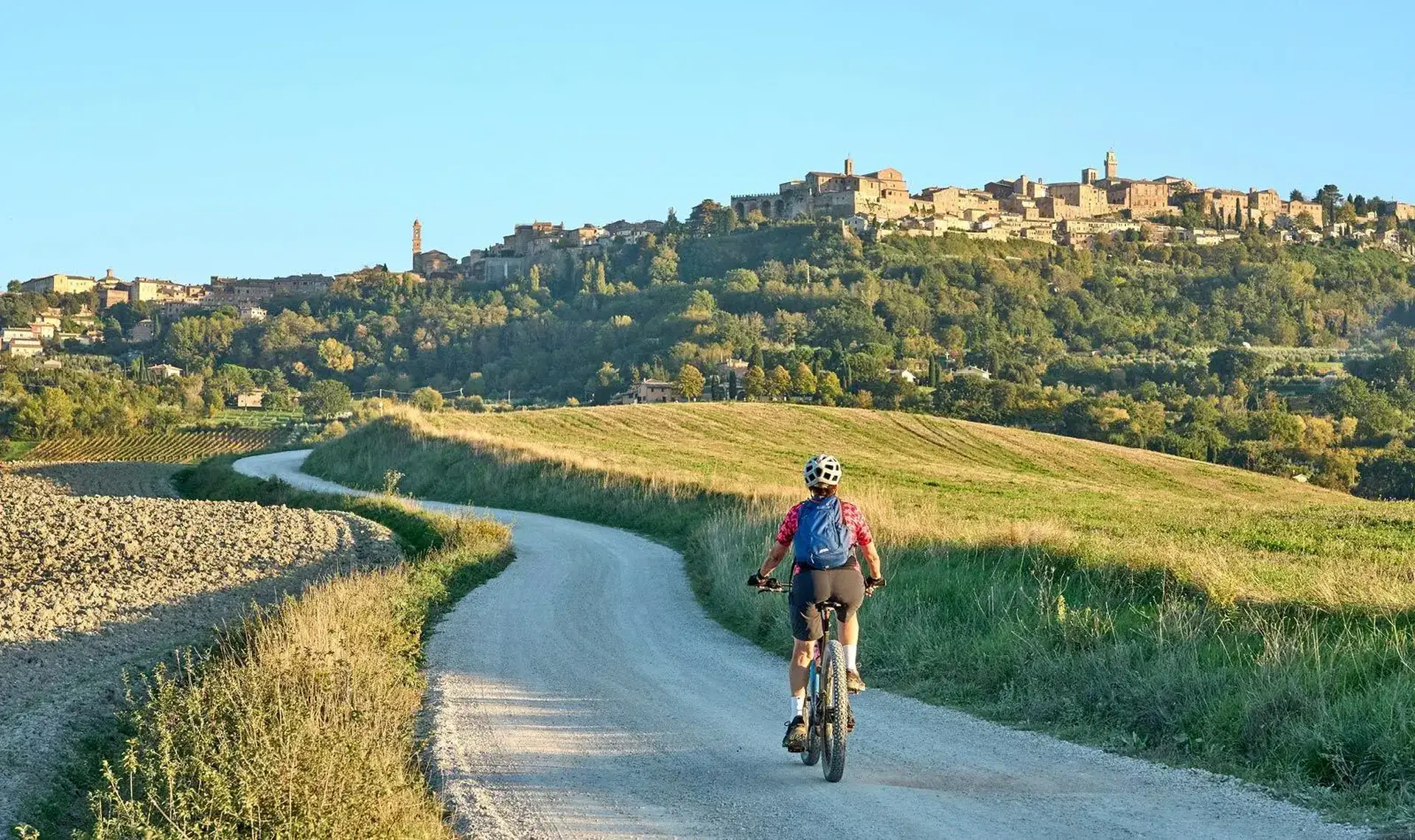
Match your fitness to the right path, from quiet gravel to historic trails.
Local knowledge makes planning cycling routes in Tuscany simple and safe.
Book a quick chat or download a free guide to start your trip.
The smell of cypress trees and warm dust fills the air as you pedal through rolling hills. Choosing the right cycling routes in Tuscany depends on your fitness, bike type, and travel style. Whether you want a quiet dirt path or a historic pilgrimage trail, honest planning is key. Sunlight hits the golden wheat fields. The sound of tires on white gravel echoes in the quiet valleys.
At Tuscany Bike Route, our founder’s racing background and deep family heritage in the region help riders pick realistic paths. We know which hills are steep and which farms serve the best espresso. This local knowledge turns a stressful plan into a smooth ride. You can learn more about our roots on our About Us page. Our goal is to give you a clear, factual guide for your trip.
How to Choose Your Riding Style
Your bike choice shapes your trip. When mapping out cycling routes in Tuscany, consider the surface. Road bikes are fast and smooth on paved country lanes. If you need a high-performance machine, check out our road bike rental options in Florence. Gravel bikes offer more grip and comfort on mixed surfaces. E-bikes open up steep hills to riders of all fitness levels.
Think about your daily distance. A relaxed rider might cover 40 kilometers a day. A fit cyclist can easily handle 80 kilometers. Always factor in rest stops and sightseeing.
Signature Routes Across Tuscany
Here are four distinct ways to experience the region. These are the most popular cycling routes in Tuscany for different riding styles.
Gravel Adventures The white roads are iconic. A gravel cycling holiday in Tuscany offers a mix of dirt paths and quiet country lanes. You avoid heavy traffic and see hidden villages. Who it’s for: Adventurous riders who want to explore off the main roads.
The Historic Path This ancient trail connects Canterbury to Rome. A Via Francigena self-guided cycling trip lets you ride at your own pace, stopping at medieval abbeys. Who it’s for: History lovers and steady-paced cyclists.
The Rugged Trail The Tuscany Trail is a scenic, off-road route perfect for mountain bikes or sturdy e-bikes. It winds through deep forests and rocky ridges. Who it’s for: Riders seeking nature and off-road thrills. Check our Tuscany Trail bike and e-bike rental options.
The Classic Challenge Famous for its steep, white gravel climbs, this route tests your legs. You can review the <a href=”https://www.strade-bianche.it/” target=”_blank” rel=”noopener noreferrer”>official Strade Bianche route details</a> for elevation context. Who it’s for: Fit cyclists looking for a classic challenge. We provide dedicated Strade Bianche bike and e-bike rental setups for this exact terrain.
Logistics make or break your cycling routes in Tuscany experience. Planning requires attention to daily distance and support.
Route Type
Best Bike
Daily Distance
Difficulty
Gravel Paths
Gravel Bike
50–70 km
Moderate
Historic Path
Road or E-bike
40–60 km
Easy to Moderate
Rugged Trail
MTB or E-bike
30–50 km
Hard
Classic Challenge
Road or Gravel
60–90 km
Hard
You do not have to carry everything on your back. As of July 2026, our rental fleet is fully updated with the latest models. We also offer Camper Caravan & Luggage Transfer services to keep your ride light. For a fully supported experience, look into our Via Classica ride and stay packages.
Tours List View
Ready to see all your options? Compare all tours to find the exact match for your budget and dates.
Key Takeaways
Pick a route that matches your current fitness level.
Use the right bike for the terrain, whether gravel, road, or e-bike.
Lean on local expertise to handle logistics and bookings.
If you have specific questions, book a quick chat with our team. We are here to help you build a realistic, enjoyable itinerary. Reach out via our Contact page anytime.
Picking the right Tuscany bike tour company comes down to budget, support level, and how much planning you want to do yourself.
Self-guided trips cost less and give more freedom. Fully supported trips cost more and remove every logistical decision.
Compare real operators side by side, not just their marketing pages, before you book.
Introduction
Early morning in the Val d’Orcia. Mist sitting low over the vineyard rows. Gravel crunching under your tyres before the sun clears the ridge. This is the Tuscany most riders come for. Getting there safely, on the right roads, at a pace that suits you, depends almost entirely on which Tuscany bike tour company you pick.
Every operator says similar things: local roads, small groups, real experiences. The actual differences show up in the details. How routes are built. Who answers the phone at 7am when a flight changes. What happens if a hotel booking falls through two days before departure.
This guide walks through what changes between tour styles, what to ask before you book, and where to look depending on the kind of trip you want: self-guided, fully supported, solo and social, or corporate. There is no single right answer here. A first-timer training for two weeks and a couple riding for a 25th anniversary need different things from the same 200km of road.
A good place to see what a family-run, self-guided operator actually looks like in practice is the Tuscany Bike Route homepage.
Local depth matters more than most riders expect before their first trip. A route built by someone who has raced these roads and ridden them for two decades knows which climb holds shade until 2pm and which descent turns loose after rain. That kind of detail rarely shows up on a map. It comes from family history — a father who ran bike rentals here for twenty years, a son who raced competitively through the same hills before building his own routes. You can read that story in full on the About Us page. The point is not any one company. The point is that this kind of local depth changes trip quality, whichever operator you end up choosing.
What Actually Changes Between Tour Styles
Most Tuscany cycling trips fall into four broad shapes. Knowing which one fits your riding style and budget narrows the search fast.
Self-guided, route only. You get a GPX file, a map, and a support line if something goes wrong. You book your own hotels and set your own pace. Cheapest option, most planning required on your end.
Self-guided with accommodation. Same routes, but hotels or agriturismi are booked for you. You still ride alone, at your own pace, with no fixed schedule to follow.
Fully supported. A van follows your route. Bags move for you. Meals, wine tastings, and sometimes a bike mechanic are built in. This is the closest thing to a private cycling holiday, and it costs accordingly.
Fixed-date group trips. A set week, a shared house, a group of riders you have not met yet. Good for solo travellers who want built-in company without a guided tour’s rigid schedule.
Style
Typical price
Support level
Best for
Self-guided, route only
Around €20–€50
GPX file, phone support
Confident riders, DIY planners
Self-guided with stays
Around €250–€350
Route + booked accommodation
Riders who want the ride, not the logistics
Fully supported
€1,000 and up
Support van, curated extras
Celebrations, premium comfort seekers
Fixed-date group
Around €400–€800
Shared house, group meals
Solo riders wanting company
Prices vary by operator, season, and group size. Treat this as a rough map of the market, not a quote.
Questions to Ask Before You Book
How many years has this operator actually ridden these specific roads, not just sold trips on them?
Is the route fixed, or built around your fitness and dates?
What happens if you need to change plans mid-trip? Who do you call?
Are accommodation and meals included, or priced as extras later?
Is there a support vehicle, and what does it actually do — carry bags, or also handle mechanical issues?
What is the cancellation policy, in writing, before you pay a deposit?
A short planning call answers most of these faster than a website ever will.
Comparing Local Operators to Big International Names
Riders often start their search with a name they already recognise — a company seen on Instagram or mentioned by a friend who rode Tuscany last season. Two names come up constantly in this research: Eat Sleep Cycle and inGamba.
If the gravel-focused, self-guided style of Eat Sleep Cycle appeals but you would rather book with a family that has ridden these specific roads for over twenty years, this breakdown of the alternative to Eat Sleep Cycle Tuscany sets out the real differences in price, flexibility, and route design.
inGamba runs a different kind of trip — five-star, fully guided, priced well above $7,000 for a package. If that luxury standard is what you want but the price tag or fixed departure dates are not, this comparison of the alternative to inGamba bike tours lines up accommodation grade, support level, and pace side by side.
For a wider view across five or six operators at once — inGamba, Eat Sleep Cycle, Trek Travel, Backroads, and Cicloposse — the best Tuscany bike tour companies compared page puts price, flexibility, and support level into one table. It is a faster shortlist than reading five separate marketing pages back to back.
Signature Routes Across Tuscany
Once you know the style of trip you want, the route itself is the next decision. A few well-known routes cover most riding goals.
Chianti and the Val d’Orcia. Rolling vineyard roads, medieval hilltop towns, and short white-gravel sections. Who it’s for: riders who want classic Tuscany scenery without extreme elevation, well suited to Via Classica if you want accommodation handled for you.
Crete Senesi and Strade Bianche territory. Longer gravel climbs, UNESCO landscape roads, more elevation per day. Who it’s for: fitter riders chasing the routes made famous by the professional Strade Bianche race, especially anyone booking around the Strade Bianche experience.
Eroica vintage routes. Steady gravel loops built around the Eroica tradition of classic steel bikes and wool jerseys. Who it’s for: riders drawn to cycling history as much as the ride itself, best explored through the Eroica experience accommodation options.
The Tuscany Trail. A long-distance bikepacking route across the whole region. Who it’s for: experienced riders carrying gear over multiple days, supported by the Tuscany Trail accommodation package.
Tuscany plus Majorca. A two-region trip pairing Tuscan gravel with Majorca’s coastal climbs. Who it’s for: riders who want two distinct cycling cultures in one holiday, covered in the Tuscany + Majorca combo.
For solo riders, the Tuscan Fellowship fixed-date event caps the group at 16 and puts everyone in a shared farmhouse for the week. For full-support celebration trips, Sole d’Oro adds a support van, curated tastings, and airport transfers. And for any multi-day route where carrying weight is the main deterrent, the Camper Caravan & Luggage Transfer service moves your bags stage to stage.
Compare all tours →see the full tour list to check dates, pricing, and inclusions side by side.
Practical Planning Notes
Spring (April–May) and autumn (September–October) carry the most stable weather and the least heat. Summer rides are doable but plan early starts to beat the midday sun. Winter opens up quieter roads for riders who prefer solitude over crowds.
Bring your own bike if you are attached to your fit and gearing. Rent locally if you are flying and do not want to box a bike — it removes one large piece of travel stress and usually costs less than checked baggage fees both ways.
Book your planning call before locking dates, especially in peak months. A short conversation about fitness level and daily distance prevents most mid-trip problems before they start.
The right Tuscany bike tour company depends on how much planning, support, and company you actually want — not on which one has the best marketing.
Self-guided trips cost less and reward confident planners. Fully supported trips cost more and remove the logistics entirely.
Local operating history and route knowledge built over years, not seasons, tends to show up in the small details that matter mid-ride.
Comparing named alternatives — Eat Sleep Cycle, inGamba, and a wider field of operators — narrows your shortlist faster than reading marketing pages one at a time.
Book a short planning call before locking in dates, especially during peak spring and autumn months.
Luxury bike tour providers in Tuscany with accommodation included range from fully supported multi-day tours to self-guided ride-and-stay packages — this guide gives honest, practical criteria to help you choose.
The best packages bundle road-tested routes, daily luggage transfer, and hand-picked lodging — from working agriturismi to countryside boutique hotels.
Whether you want a supported road challenge through the Val d’Orcia or a relaxed e-bike tour through wine country, Tuscany has a premium option that fits your pace.
Introduction
There is a particular kind of morning in Tuscany that cyclists talk about for years. Mist sitting low on the wheat fields south of Siena. Espresso at a stone-counter bar, no one in a hurry. Then you clip in, and the road unrolls ahead — cypress trees, ochre farmhouses, the faint smell of wild rosemary.
This is not a fantasy. It is what a well-planned bicycle tour in Italy actually delivers — when the accommodation, the route, and the logistics are matched correctly from the start.
Finding luxury bike tour providers in Tuscany with accommodation included is not as simple as picking the most polished website. Some packages are genuinely premium. Others use the word “luxury” loosely. This guide cuts through that with honest, practical criteria — so you can choose the right trip for your riding level, group type, and budget.
Tuscany Bike Route is a family-run local operator built on deep roots in the region. The founder’s racing background and years of physical scouting on Tuscany’s roads inform every itinerary. You can read more about that story on the About Us page. Throughout this article, you’ll find natural references to their tours as concrete examples — but the core guidance works for any operator you consider.
Whether you are planning a solo challenge, a couples escape, a corporate retreat, or a small-group cultural trip, Tuscany rewards the prepared cyclist. Read on.
Luxury Bike Tour Providers in Tuscany with Accommodation Included
Luxury bike tour providers in Tuscany with accommodation included
Not every operator who offers a “luxury” cycling package in Tuscany has earned that word. Here is what genuine quality actually means — and how to check before you commit.
A credible luxury bike tour provider in Tuscany will include:
Named, handpicked accommodation — not just “4-star or above” but specifically chosen properties with character and cycling access
Daily luggage transfer, so you ride with only what you need on the bike
A support vehicle or clearly defined emergency contact, especially on multi-day stages
Routes that have been physically scouted — not pulled from a mapping app and never ridden
A local contact who picks up the phone — not a remote call centre working from a script
Feature
Standard Tour
Luxury Tour
Accommodation
Hotel listed at booking
Named, curated properties
Luggage
Self-carry or extra cost
Included daily transfer
Route Notes
Generic PDF
Personalised, road-tested stage guides
Support
Emergency number
Vehicle + local contact available
Food & Wine
Self-arranged
Curated tastings or included meals
Multi-day bike tour Tuscany packages vary widely — five nights, ten nights, fully catered or restaurant-free. Neither format is wrong. The match to your preferences is what matters.
The best bike touring Italy operators build in flexibility. Groups change. Weather changes. A rigid itinerary with no room to adapt is not luxury — it is just expensive.
Tuscany Guided Bike Tours Wine and Food with Lodging
Food and wine are not optional extras in Tuscany. They are the point.
The best bike tours on the roads of Tuscany are built around the landscape — and that landscape produces Brunello di Montalcino, Vernaccia di San Gimignano, Pecorino di Pienza, wild boar salumi, and hand-rolled pici pasta. A well-designed tour puts you in reach of all of it, without making it feel like a checklist.
What does “wine and food with lodging” actually mean in practice?
Entry-level packages include breakfast and one group dinner. Wine tastings are usually paid separately and optional.
Mid-range packages often include one curated cellar visit and one included tasting. Restaurants are booked in advance but not always pre-paid.
Premium packages include winery visits with a local host, at least one evening with a dedicated food guide, and accommodation at properties where the kitchen is part of the experience — an agriturismo that grows its own olive oil, or a wine estate with a private chef.
When comparing Tuscany bike touring packages, ask specifically: what is included in food and wine, and is it genuine local access or a standard restaurant booking anyone could make?
Guided tour structures also vary. Some operators ride with you the full day. Others position a guide at key waypoints. A few rely on GPS-only systems — fine for confident navigators, but not what most people mean when they say “guided.”
For groups with mixed fitness levels, a Tuscany e-bike tour option is worth including. E-bikes level the playing field on Tuscany’s hills and allow everyone to reach the same farmhouse for lunch without anyone suffering unnecessarily.
Tuscany Bike Tour Company Luxury Hotels Included
Some cyclists want a proper hotel — a spa, a pool, a wine list. Others prefer an agriturismo embedded in a working farm, where dinner feels like a family meal. Both are “luxury” — just different versions of it.
When a Tuscany bike tour company says “luxury hotels included,” check three things:
1. Are the hotels named? Generic “4-star accommodation” is not a promise. Named, confirmed properties are. Ask for the list before you book.
2. Are they located on the route? A hotel 25km from the next day’s start is inconvenient. Good operators plan stage stops that flow logically, so mornings start from the front door, not from a transfer vehicle.
3. Do they accommodate cycling kit? Bike storage, kit-drying facilities, and early breakfast — before 7am — are practical necessities on a multi-day bike tour Tuscany itinerary. The nicest hotels in Tuscany for cycling are often the ones that understand these logistics as well as they understand interior design.
Some of the luxury resorts in Tuscany that attract cycling groups also function as luxury Tuscany wedding venues — think Castiglion del Bosco, Borgo Santo Pietro, Adler Thermae. Beautiful properties. But check whether they are genuinely set up for cyclists, or whether cycling is an afterthought alongside the spa programme.
The most luxurious hotels in Tuscany for cycling trips tend to be outside the main tourist hubs — Montalcino, Pienza, Bagno Vignoni, San Quirico d’Orcia. These towns have character, excellent food, and direct access to the quieter roads.
For a concrete example of how accommodation is curated into a supported cycling package, the Sole d’Oro supported cycling tour maps stage stops directly to daily routes — so nothing is left to guesswork on arrival.
Luxury Cycling Tour Operator Tuscany with Accommodation
Choosing a luxury cycling tour operator in Tuscany with accommodation comes down to four practical questions.
1. Is the operator actually based in Tuscany?
This matters more than it sounds. An operator rooted in the region knows which roads are dangerous after rain, which hotels serve breakfast at 6:30am, and which routes get congested in August. Remote operators often rely on fixed itineraries and local subcontractors who may never have met.
2. Do they offer genuine on-the-road support?
For cyclists, genuine support means: a vehicle that can reach you if a mechanical issue can’t be fixed roadside, accommodation confirmed at each stage, and a contact who picks up the phone. Not a chatbot. Not an email form.
3. Can they accommodate different riding levels in the same group?
A good operator builds tours that work for mixed groups. This is where Tuscany e-bike tour options have grown significantly — they make Tuscany’s climbs accessible without requiring a competitive fitness base, which opens the door for couples, corporate groups, and multigenerational trips.
4. Do they have a track record on these specific roads?
Ask for real testimonials. Ask which roads they use. Ask what happens if weather forces a route change. If answers are vague, that tells you something.
For self-guided cycling tours in Italy — where you ride independently but with full logistical support — the operator’s preparation work is everything. Route notes need to be detailed. Accommodation needs to be confirmed, not provisional. Emergency contacts need to be real people.
The Via Classica ride and stay is an example of a well-structured self-guided format with accommodation and luggage logistics built in. The Tuscan Fellowship takes a different approach — small group, shared experience, guided throughout.
Both are valid. The choice depends on your group’s preference for independence versus company.
Best Luxury Accommodation by Tuscany Bike Tours
The best luxury accommodation selected by serious Tuscany bike touring operators shares a few consistent characteristics.
Location above all else. The property should sit on or close to the route — not require a long detour. Waking up and rolling onto open road within five minutes is the goal. Properties that require a 20km transfer before the day’s stage begins eat into riding time and dilute the experience.
Character over category. A restored 13th-century monastery with thick stone walls and a walled garden is more memorable than a generic five-star hotel, even if the category rating is technically lower. The best luxury accommodation on Tuscany bike tours tends to be properties where staff understand that cyclists need an early start and a quiet space to sort their kit.
Practical details count. Secure, dry bike storage. A room for wet kit. Breakfast before 7am. High-energy food options — not just cornetti and coffee. These are non-negotiable on a serious multi-day cycling itinerary.
The Tuscany Trail accommodation guide covers properties along one of Italy’s most celebrated bikepacking routes and gives a useful sense of the range available across different accommodation types and price points — from mountain rifugi to boutique rural hotels.
To compare how accommodation is integrated across different tour styles and durations, compare all tours for a clear overview of what is currently on offer.
Luxury Cycling Holidays in Tuscany
A cycling holiday in Italy that qualifies as genuinely luxurious has a rhythm to it. Hard mornings in the saddle. Good food at midday. An afternoon that slows down. A dinner that stretches into the evening.
Tuscany does this naturally. The landscape, the food culture, and the pace of life align precisely with what the best bike touring Italy cyclists describe when they come back and talk about the trip for years.
What makes a cycling holiday in Tuscany feel luxurious rather than just expensive?
Time built into the itinerary — not every day pushed to maximum distance
Routes that include scenic stops, not just cycling kilometres
Accommodation that feels local, not interchangeable with any other region
An operator or guide who knows when to push and when to rest
The Eroica experience and the Strade Bianche gran fondo accommodation package add a specific cultural moment to a premium trip — riding the same roads that professional cyclists race on, in the same week. That is a different kind of experience from a standard touring package.
For riders who want to link two of Europe’s best cycling destinations in one trip, the Tuscany + Majorca cycling combo offers a structured way to combine different terrain, different light, and the same quality of logistics across both regions.
For practical questions about fitness levels, road surfaces, and what to bring on a luxury cycling holiday in Italy, the FAQ page covers the most common concerns in detail.
Luxury Places to Stay in Tuscany
Tuscany’s accommodation landscape is one of the richest in Europe. For cyclists, “luxury” is more specific than thread counts and infinity pools.
Agriturismo — farm stays with their own agricultural production — are often the most memorable stops on a cycling itinerary. Many produce wine, olive oil, or Pecorino cheese on site. Meals use ingredients grown within walking distance of the table. The standard varies enormously; a well-chosen agriturismo beats an average five-star hotel every time in terms of atmosphere and local authenticity.
Borghi — restored medieval hamlets — represent the highest end of the Tuscany accommodation spectrum. Castel Monastero, Borgo di Vicarello, Rosewood Castiglion del Bosco. These are full estate experiences with their own restaurants, pools, and spas. Some accommodate cycling groups well; others are primarily leisure-focused. Check before assuming.
Historic town hotels — smaller properties within the old walls of Montalcino, Montepulciano, or Cortona — give direct access to wine bars, morning markets, and local coffee culture. These suit groups who want town life alongside the riding.
Thermal spa hotels — particularly around Bagno Vignoni and the wider Val d’Orcia — combine physical recovery with outstanding scenery. After a long day on the bike, a thermal pool at sunset is a strong argument for building a rest day into the itinerary.
The key is matching property type to your group’s real priorities. A competitive cyclist prioritises early breakfast and secure bike storage. A couples retreat prioritises atmosphere and wine. A corporate group often wants both — with a meeting room and reliable Wi-Fi added in.
For specific accommodation questions or to discuss the right fit for your group size and dates, the contact page connects you directly with someone who knows these properties personally, not from a brochure.
Luxury Hotels in Tuscany Countryside
The Tuscany countryside — specifically Chianti Classico, Val d’Orcia, Crete Senesi, and Maremma — holds the most photographed cycling roads in Italy. It also holds some of the most beautiful rural hotel properties in Europe.
Here is a practical breakdown by zone:
Chianti Classico Wine-estate hotels with direct access to gravel and tarmac roads. Strong food and wine offer throughout. High season demand — book 6-9 months ahead. This is where many of the well-known luxury resorts in Tuscany sit, and where road cycling routes connect most naturally to the strade bianche aesthetic.
Val d’Orcia UNESCO World Heritage landscape. Cypress-lined roads. Thermal spas nearby. Fewer crowds than Chianti in high season. The scenic quality here is simply unmatched — these are the roads that define Tuscany in the imagination, and riding them at dawn is worth planning a trip around.
Crete Senesi Rolling clay hills south of Siena. Less visited than Chianti or Val d’Orcia. The roads here feature in Strade Bianche-style gravel routes. Accommodation is more intimate — smaller properties, more personal service, and lower prices for comparable quality.
Maremma Wild coast, Monte Argentario, Etruscan roads through pine forest. Growing in popularity among cyclists who want a coastal element. Properties here suit riders who want maritime scenery alongside the interior roads.
For detailed route descriptions by zone, seasonal road conditions, and practical tips on riding each area, the blog hub covers Tuscany’s cycling landscape in depth.
If you are travelling without your own bike, road bike rental in Florence and Tuscany is available with quality carbon options suited to both tarmac and light gravel.
For trips where luggage logistics are a challenge — particularly self-planned itineraries — the camper caravan and luggage transfer service solves the practical problem of riding free without managing your bags.
Signature Routes: Practical Options for Different Rider Types
Once you know what to look for in accommodation and operator quality, the next step is matching a route format to your group.
Sole d’Oro — Fully Supported Multi-Day Tour Tuscany Bike Route’s premium supported tour covers the southern Tuscany roads: Val d’Orcia, Crete Senesi, and the wine zones. Accommodation, luggage transfer, and a support vehicle are included throughout. It suits experienced riders who want a premium package without managing any logistics. Full Sole d’Oro tour details →
Via Classica — Self-Guided Ride and Stay Curated stages, confirmed accommodation, and detailed daily route notes. For riders who want independence with structure — and without the anxiety of planning accommodation from scratch. Via Classica details →
Tuscan Fellowship — Guided Small Group Small group, guided, social. For those who want the energy of riding with others and a guide who knows the roads personally. Tuscan Fellowship details →
Tuscany + Majorca Combo — Two Regions, One Booking For riders who want to combine two of Europe’s best cycling destinations. Different terrain, different light, same quality of support. See the combo tour →
A few honest notes before you book any luxury cycling package in Tuscany:
Best season: April–June and September–October give the best combination of weather, road conditions, and available accommodation. July and August are hot and crowded. Winter riding is possible in the south — Val d’Orcia and Maremma stay rideable — but accommodation options become limited.
Fitness honesty: Most luxury packages are designed for riders with a moderate base — not racing cyclists, not complete beginners. Ask your operator what the daily average distance looks like in practice, and whether e-bike options are available if someone in the group needs them.
Group size: Small groups of 4-8 riders get the most from a luxury cycling holiday. Larger groups add logistical complexity. Some properties cap at 10-12 guests.
Booking lead time: Premium properties in peak season book out 6-12 months ahead. If you have specific dates, start the conversation early.
Tuscany Trail complete guide — clear, local advice for every rider.
Routes, gear, maps, costs, and the Chianti detour explained.
Practical tips for self-supported and guided trips.
Introduction
The Tuscany Trail complete guide opens with one simple promise: honest, local answers for real riders. I write as someone who grew up riding the hills and scouting lanes. I know where the gravel bites, where a café will refill your water, and where a farm will offer a spare pump.
If you want a quick planning hand, start at the homepage: https://tuscanybikeroute.com/. My family’s foundation in guiding and racing means routes are tested by riders and refined with local knowledge. For a short note on who we are, see About Us.
You will find practical options for long single-day rides, multi-day self-supported trips, and corporate cycling retreats. This guide answers the common questions riders ask. It also links to route files, maps, and rental options to save you time when you plan.
How hard is the Tuscany Trail
Difficulty depends on route choice and bike. The surface mixes paved roads, gravel tracks, and old farm lanes. Expect long climbs, short steep pitches, and loose sections. Fitness matters. Technical skill matters.
For many riders the route is moderate to hard. A fit rider who trains a few times a week will find the days long but do-able. For inexperienced riders a guided option or shorter daily distances is safer.
Train for time in the saddle and varied terrain. Key prep:
Build endurance with back-to-back long rides.
Practice gravel handling and short steep climbs.
Check your bike: tires, brakes, drivetrain.
Pack layered clothing; Tuscan weather shifts.
Learn basic repairs: tyre change, chain tool, spare spokes.
Download route files early and inspect elevation profiles. Grab the Tuscany Trail GPX and a printable Tuscany Trail Map to plan water stops and services. If you prefer to rent a bike, review our road bike rental options.
Chianti detour Tuscany Trail
The Chianti detour Tuscany Trail is a classic option. It adds vineyards, rolling climbs, and quieter lanes. It also adds some soft gravel and extra climb metres.
Choose it if you want scenic wine-country riding and can handle frequent short climbs. Expect tighter lanes and more touristic villages, so ride early to avoid traffic. Maps and GPX that include the detour are available — see the free guide.
(If you are looking specifically for the Tuscany Trail Chianti detour, we include both GPX and map layers in the guide.)
Tuscany Trail Chianti detour
A short note on logistics for the Tuscany Trail Chianti detour: accommodation fills early in peak months. Book B&Bs in advance and confirm luggage transfers if you plan support. For accommodation planning see here.
Tuscany Trail starting point
Many riders begin near Florence or the Chianti hills. The true Tuscany Trail starting point is flexible. Choose one that suits travel plans and transfers.
If you need guidance we can suggest start towns and transfer logistics. Use our contact page to arrange transfers or a shuttle: https://tuscanybikeroute.com/contact/.
Tuscany Trail bike rental
If you need a bike, booking early is wise. For high-quality road and gravel bikes check our road hire service. Rental tips:
Book to match tyre width for gravel.
Request a test fit.
Ask about spare parts and drop-off/pick-up options.
Tuscany Trail Map
A clear Tuscany Trail Map makes daily planning simple. Maps should show surfaces, resupply points, and alternative routes like the Chianti detour. We provide printable maps and layered GPX files. Get a free route + guide here.
If you want to compare tour options and see map previews, Compare all tours.
Tuscany Trail GPX & Tuscany Trail 2025 GPX
GPX files are essential for off-road sections and navigation. We offer updated GPX sets. Look for Tuscany Trail GPX that includes the Chianti detour and alternative loops.
For riders planning in advance, it helps to check the Tuscany Trail 2025 GPX and Tuscany Trail 2026 files as they can contain small route updates.
Tuscany Trail 2025 and Tuscany Trail 2026 dates
If you want event-style timing or local closures, consult the updated dates. Riders often check Tuscany Trail 2025 and Tuscany Trail 2026 dates for scheduling. If your trip aligns with a local event we can advise alternate routing. For event-themed rides, see our Eroica experience and Strade Bianche packages
How to ride the Tuscany bike Trail and planning tips
The phrase Tuscany bike Trail covers many variations. Pick a realistic daily distance. Factor in unpaved sections. Pack light. Use local stops. If planning a corporate retreat or group trip, a guided format solves logistics and risk management.
Signature Routes Across Tuscany
Below are tested route options. Each includes a short “who it’s for” note.
A day of rolling vineyards, short climbs, and cellar stops. Who it’s for: riders who want iconic scenery and moderate effort. See Chianti options in our Tuscany Trail Map and GPX files.
Crete Senesi Gravel Day
Hard-packed gravel lanes and lunar landscapes. Who it’s for: gravel bikes and confident handlers. Ideal as a stage on a longer Tuscany Trail bike ride.
Eroica Vintage Route
A nostalgic route with white roads. Book the Eroica experience here. Who it’s for: classic-bike lovers and photo-focused groups.
Strade Bianche Challenge
A mix of pro-race sectors and scenic climbs. Packages at Strade Bianche Accommodation. Who it’s for: sport cyclists wanting a high-effort day.
For a full list and to compare details use the Tour List view.
best cycling routes in Tuscany: clear local choices for road, gravel, family and beginner rides.
Short rides around Chianti and Val d’Orcia. Longer options like the Ciclovia del Sole and Strade Bianche sectors for fit riders.
Practical tips on gear, timing, and how a local operator (Tuscany Bike Route) helps with bikes, luggage and routes.
Introduction
If you want to plan a bike trip in Italy, start here. This guide names the best cycling routes in Tuscany. It gives practical choices for different riders. I write as a local operator with family roots in road and gravel racing. Our site, the Homepage, grew from that. Read on for honest options and realistic distances. I will show routes for beginners, mixed-surface riders, and strong road cyclists. I will include day options and multi-day tours. I will also note when to ask a local for help. See About Us for how local scouting shapes these routes.
Best bike touring in Italy
Italy has many cycling landscapes. Tuscany mixes low hills, river valleys, and longer climbs. For touring, choose roads with services every 20–50 km. The Ciclovia del Sole (part of EuroVelo 7) runs through Tuscany and is useful for longer self-guided rides.
Who this is for:
Riders who want multi-day travel with luggage transfer.
Cyclists who prefer a steady rhythm of 50–90 km per day.
Groups that want local support, rentals, and maps.
Practical note: a local operator can arrange road bike rental, luggage transfers, and hotels. We help set realistic daily distances and avoid busy roads.
best bike routes in Tuscany
Below are classic choices. Each entry ends with “who it’s for”.
1. Chianti loop (50–80 km). Rolling vineyards. Short stone lanes. Good food stops. Light climbing. This is an ideal day bike tour in Tuscany or a short multi-day starter. Who it’s for: first-timers to Tuscan hills and anyone who wants wine-and-ride stops.
2. Val d’Orcia circuit (40–70 km). Iconic views and gentle climbs. Quiet roads and hard-pack lanes in parts. Great for photography. Who it’s for: leisure riders and photographers.
3. Strade Bianche sectors (gravel mixed). White gravel roads (sterrato) around Siena and Gaiole. You can ride short loops or long sportives. The scene here inspired L’Eroica and Strade Bianche races. Who it’s for: gravel riders and riders seeking classic sterrato.
4. Arno Cycle Path & Pisa to Florence section. Flat, mostly paved. Suited for families. Easy logistics and trains at endpoints. Who it’s for: family bike trips and beginners.
5. Ciclovia del Sole (Tuscan section). Long-distance, varied terrain. Good for multi-day self-supported touring. Who it’s for: long-distance touring riders and EuroVelo seekers.
Signature Routes Across Tuscany
Below are routes we scout and run. I include short notes and who each is for. If you want to compare options, see the Tours List view — Compare all tours is there.
Strada Serena — Classic day and multi-day loops. Smooth paved climbs, calm traffic. A balanced Tuscan cycle route for fit riders. See full GPX and notes at Strada Serena. Who it’s for: trained road cyclists wanting steady elevation.
Via Classica — Ride and stay. A mix of scenic lanes and heritage towns. Hotels picked to suit cyclists. Details: Via Classica. Who it’s for: riders seeking comfort after the day’s effort.
Sole d’Oro — supported cycling in Tuscany. A supported tour with luggage and mechanical backup. See Sole d’Oro. Who it’s for: riders who want minimal logistics and solid local support.
Tuscan Fellowship — ride together, live together. A hybrid group experience that blends self-guided and guided sections. Tuscan Fellowship. Who it’s for: groups and corporate retreats focused on team riding.
Combine with Majorca. We offer a Tuscany + Majorca Combo for winter training and spring prep. Tuscany + Majorca Combo. Who it’s for: riders seeking varied climates and structured weeks.
This heading answers the core question again. There is no single “best” route. It depends on fitness, surface preference, and trip length. For clarity:
Day trips: Chianti loop, Val d’Orcia.
Gravel focus: Strade Bianche sectors and L’Eroica loops.
Long touring: Ciclovia del Sole sections.
Small table: quick comparison
Route type
Typical day km
Surface
Who it suits
Chianti loop
50–80
paved + short sterrato
Leisure & mid-fit
Val d’Orcia
40–70
paved
Photographers & families
Strade Bianche sectors
60–120
gravel/sterrato
Gravel & fit riders
Ciclovia del Sole (Tuscan)
multi-day
mixed
Long tourers
best road cycling destinations Europe
Tuscany is among Europe’s respected road cycling regions. It sits with other destinations like Girona, Mallorca, and the French Alps. For winter training many riders pair Majorca with Tuscany for varied terrain and warmth. See our Tuscany + Majorca Combo for one practical option.
For context on Euro-wide routes, EuroVelo’s Sun Route is a backbone that links long-distance itineraries across Italy.
Who it’s for:
Teams training in spring.
Road cyclists seeking mixed climbs and steady climbs.
Event riders preparing for Gran Fondos.
Practical planning: gear, seasons, and logistics
Seasons: spring and early autumn are best. Summer is hot. Winter can be wet. Pack layers. Use a local operator for weather-based route tweaks.
Bikes: choose wheels and tires by surface. Road bikes for paved loops. Gravel or mixed tires for Strade Bianche sectors. We supply road bike rental and can advise on tire choice.
Support and services: consider luggage transfer, a support van, or a camper caravan. We offer Camper Caravan & Luggage Transfer. Use the Contact page to request a tailored plan.
How local expertise helps
Local scouting matters. Roads change. Farm vehicles shift priorities. Our family history in racing and local guides mean we know which lanes stay quiet and which climbs are better avoided midday. We also run special experiences like the Eroica experience and Strade Bianche-focused stays. These are practical ways to sample the sterrato safely.
Final call
If you want to compare options, use the Tours list. Compare all tours and pick the style that fits your group. For a free regional route and planning guide, Get your free route + guide
Key Takeaways
Pick a route that fits fitness and surface preference.
Start with short days if new to Tuscan hills.
Use local rental, luggage transfer, and guided notes to keep the ride safe and simple.
For longer trips, the Ciclovia del Sole and linked EuroVelo routes work well.
Tuscany bike trip: clear, local advice for beginners to climbers.
Routes, timing, packing, 7-day sample, and realistic budgets.
Free GPX routes, rentals, and guided options for every rider.
Why Tuscany is Europe’s #1 Cycling Destination
A Tuscany bike trip feels like stepping into a live painting. Olive light on cypress rows. Gravel that smells of sun and dust. My name is Marco, founder of Tuscany Bike Route. I grew up here. My family ran a small trattoria on a hill road. I raced as a young rider and guided groups for twenty years. That mix of racing discipline, family hospitality, and local route-knowledge shapes every route we scout. That is how we set realistic daily distances and avoid roads that look great on a map but are poor for a loaded bike.
“Over 24,000 km of cycling routes, 73 UNESCO sites, and endless strade bianche.” It’s a bold claim we use to capture imagination. For the official route counts and the region’s protected sites, Visit Tuscany lists thousands of kilometres of itineraries and multiple UNESCO sites across the region; these resources are handy when you plan season and stops.
This guide will give practical help for different rider levels, trip styles (self-guided or supported), and company retreats. You’ll get concrete routes, packing lists, and a sample 7-day plan you can adapt.
Choosing Your Route
Picking a route starts with honesty about fitness and time. Below are three archetypes, with distances set for loaded touring or pacey road riding.
Beginner — Chianti wine valleys (flat to rolling, 30–40 km/day)
A forgiving loop between Greve, Panzano, and Castellina. Smooth roads, short climbs, frequent cafés and wineries. Who it’s for: first-timers, mixed groups, corporate retreats wanting scenic, social rides. Useful link: road bike rental if you prefer to travel light. (See our Road bike rental.) https://tuscanybikeroute.com/road-bike-rental-tuscany-florence/
Intermediate — Val d’Orcia loop (rolling hills, 50–70 km/day)
More ups, sweeter descents. Towns like Pienza and Montalcino reward effort. Gravel side roads (strade bianche) add variety. Who it’s for: regular club riders and confident holiday riders.
Spring (April–June) and early autumn (September–October) are the best windows for mild days and quieter roads. Summer brings heat and local festivals; winter can bring rain and short daylight. Many riders aim for late April–early June to catch wildflowers and lighter traffic.
Short checklist (visual infographic idea): helmet, gloves, lightweight rain jacket, two bibs, 3 jerseys, chamois cream, multi-tool, spare tubes, mini-pump, patch kit, travel charger, compact lock, small first aid.
Gear notes: a light road bike with 28–32 mm tyres works for sealed roads. Choose wider tyres for gravel or strade bianche. For mixed surfaces, an endurance or gravel frame is the best compromise. We offer rentals if you prefer not to travel with a bike. https://tuscanybikeroute.com/road-bike-rental-tuscany-florence/
Day 1 — Florence to Chianti (55 km, +650 m). Gentle warm-up through olive groves. Stay in Panzano. Day 2 — Chianti loop (40 km, +800 m). Vineyards, light gravel detour to a family winery. Top wineries to visit on Chianti bike route include Antinori and small family estates; plan tastings in the afternoon. Day 3 — Chianti to Siena via Strada Serena (70 km, +1,200 m). Town piazzas and local trattorie. (Link to Strada Serena.) https://tuscanybikeroute.com/strada-serena-tuscany-by-gpx/ Day 4 — Siena rest or short ride (25–40 km). Recovery day, explore town. Day 5 — Siena to Val d’Orcia (85 km, +1,800 m). Longer day with rolling climbs toward Pienza. Day 6 — Val d’Orcia loop (60 km, +1,100 m). Iconic views and small hilltowns. Day 7 — Return to Florence or transfer to coast (60–100 km depending on route).
Each day includes an approximate km and elevation. For groups we can provide an embedded Google Map with the saved route and waypoint notes on food stops. Want us to plan your entire trip? Check out Via Classica for fully planned itineraries. https://tuscanybikeroute.com/via-classica-ride-and-stay/
A classic Tuscany bike trip itinerary lasts 5 to 7 days and links Florence, Chianti, Siena, and Val d’Orcia. Daily distances usually range from 30 to 80 km, with rolling hills, vineyard roads, and historic hill towns. Most riders include one lighter recovery day in Siena or Pienza to balance the climbing and enjoy local food and wine.
Tuscany bike trip map
A good Tuscany bike trip map combines paved secondary roads with selected gravel strade bianche. GPX navigation is the most practical option, allowing riders to follow quiet countryside routes, locate cafés and water stops, and avoid heavy traffic near major cities. Maps typically connect Florence, Greve, Castellina, Siena, and the Val d’Orcia loop.
Tuscany bike tours self guided
Self-guided Tuscany bike tours include pre-booked accommodation, GPX routes, luggage transfer options, and local phone support. Riders cycle at their own pace without a guide while still having structure and logistical help. This format suits independent travelers, couples, and small groups who want flexibility with reliable planning.
3 day bike tour Tuscany
A 3 day bike tour Tuscany experience usually focuses on Chianti. Day one rides from Florence to Greve. Day two loops through vineyards and hill towns. Day three continues toward Siena or returns to Florence. Distances average 40–70 km per day, making it achievable for moderately fit beginners.
4 day bike tour Tuscany
With four days, riders can include both Chianti and a short Val d’Orcia section. This allows one relaxed riding day and more time for wine tastings or cultural stops. Daily stages remain manageable while offering a fuller sense of landscape variety and Tuscan rhythm.
Best tuscany bike trip
The best tuscany bike trip depends on fitness, time, and travel style. Many riders consider a 7-day Florence–Chianti–Siena–Val d’Orcia loop the most balanced option. It combines iconic scenery, reasonable climbing, strong food culture, and smooth logistics without requiring extreme endurance.
One day bike tour Tuscany
A one day bike tour Tuscany route often starts near Florence, Lucca, or central Chianti. Typical distances range from 30 to 90 km. Riders enjoy vineyard views, quiet rural roads, and a long lunch stop before returning to the starting point or train station.
Tuscany bike tours reviews
Tuscany bike tours reviews frequently highlight scenic countryside, welcoming agriturismi, and well-marked GPX routes. Positive feedback often mentions luggage transfer convenience, authentic local food, and the balance between cycling challenge and relaxation.
Best time of year for Tuscany bike trips in 2026
The best time of year for Tuscany bike trips in 2026 will again be April through June and September through October. Spring brings green hills and mild temperatures. Early autumn offers warm light, harvest season food, and fewer tourists compared to midsummer heat.
Tuscany bike tour costs and bookings for 2026
Tuscany bike tour costs in 2026 vary by comfort level. Basic self-guided trips may start around €300–€600 per person for short stays, while full 7-day self-guided packages often range from €900–€1,400. Guided or luxury supported tours can exceed €2,000. Early booking is recommended for peak spring and autumn weeks.
Easiest Tuscany bike tours for beginners
The easiest Tuscany bike tours for beginners are found in Chianti valleys or along flatter coastal areas. Routes with daily distances near 30–40 km, gentle gradients, and frequent cafés create a comfortable first experience without long mountain climbs.
Self-guided vs guided Tuscany cycling tours
Self-guided vs guided Tuscany cycling tours comes down to independence versus support. Self-guided trips provide freedom of pace and privacy. Guided tours offer navigation help, mechanical support, cultural insight, and simplified logistics. Groups, corporate retreats, and first-time visitors often prefer guided formats.
Top bike rentals and e-bikes for Tuscany trips
Top bike rentals and e-bikes for Tuscany trips usually include lightweight road bikes with compact gearing and endurance geometry. Gravel bikes suit mixed terrain. E-bikes help riders manage long climbs or different fitness levels within the same group, extending daily range while reducing fatigue.
How many days do you need in Tuscany
How many days you need in Tuscany depends on travel goals. Three days gives a short Chianti taste. Five to seven days allows a complete cycling loop with rest time. Ten days or more lets riders explore multiple regions at a relaxed pace.
Which town to stay in Tuscany
Which town to stay in Tuscany depends on the route. Greve or Panzano works well for Chianti riding. Siena offers a central base with history and services. Pienza or nearby villages provide classic Val d’Orcia scenery and quieter evenings after long rides.
What not to miss on a 3 day bike tour Tuscany — clear route, one good winery stop, and a relaxed final afternoon.
Pick the right bike, pack light, and use a local guide or the free route + guide to keep logistics simple.
Short rides, strong coffee, and quiet gravel lanes make a true bike trip in Italy.
Introduction
What not to miss on a 3 day bike tour Tuscany is the question I hear most from riders who want a short, honest taste of the region. I’m a local guide with family roots in the hills. We race in spring and host corporate retreats. I write from that view: tried routes, tuned timing, and small comforts that matter.
You will read clear, practical advice here. The post covers route choices for different abilities. It covers what to pack, what to expect on the road, and how to choose between an e-bike and a regular bike. I link once to our homepage for quick orientation
Smell the dust on the white lanes. Hear church bells and the soft clink of a water bottle on the frame. Taste a simple pecorino and a glass of Chianti. This guide answers real planning questions for riders who want to bike through Tuscany without surprises. Local operators, like us, help with scouting and luggage, using family heritage and racing experience to set realistic daily plans. Read the About Us page to learn how that background shapes the routes.
How to use this guide
I give practical options: quiet day bike tours in Tuscany for beginners, and stronger rides for fit road cyclists. If you want a hands-off plan, we offer guided and supported choices such as road bike rental and luggage transfer. See the road bike rental page for details. https://tuscanybikeroute.com/road-bike-rental-tuscany-florence/
3 Day Bike Tour Ride Tuscany
A good three-day loop balances riding and relaxation. Typical pattern: a steady opening day, a harder central day with a stretch of hills, and a short final day to soak the views.
Sample three-day plan
Day 1: Gentle start from Florence toward the Chianti hills. 40–55 km. Easy climbs.
Day 2: Rolling vineyards, longer climbs, approx 70–95 km. The day to push if you feel strong.
Day 3: Short return with gravel lanes and a late lunch in a village. 30–45 km.
Many riders prefer self guided bike tours in Tuscany for flexibility. A well-crafted GPX and local support reduce risk. Use local rentals and a map from a trusted operator for quiet lanes. Self-guided tips:
Night before: charge devices and carry a paper copy of key turns.
Book lodging that offers bike storage.
Best cycling tours Tuscany
Choosing the best cycling tours Tuscany depends on goals. Corporate groups want routes that allow team time. Road riders want continuous miles on smooth tarmac. Mixed groups need shorter daily rides and more stops.
The Florence to Siena corridor ranges from gentle to hard. The easiest routes follow the valley lines and are mostly on quiet tarmac. The classic options include rolling climbs up to 8–10% on short sections. Expect some unpaved stretches if you follow historical lanes.
Local notes:
Fit road riders find the route moderate to hard if they extend via the Chianti ridge.
For precise elevation and distances, consult the official Tuscany cycling guide for maps and stage details. official Tuscany cycling guide
Top wineries to visit on Chianti bike route
Chianti is peppered with family wineries. A good stop combines a private tasting and a short tour of cellars. Here are reliable picks for a three-day route: smaller estates with simple tasting rooms, and one larger cellar for a full tour.
Suggested stops:
Small family cellar near Greve for a short tasting.
Mid-route agriturismo with a lunch pairing.
Larger producer near Panzano for a cellar walk.
If wine logistics matter, ask for a winery-friendly schedule when you get your free route + guide.
Packing essentials for 3 day Tuscany cycling
Packing light makes riding easier. Carry what you need for the day and let luggage move between lodgings.
Item
Why
Light rain shell
Weather can shift on the ridge
Spare tube + pump
Remote lanes, quick repairs
Sunscreen & cap
Sun gets strong in late spring
ID & cash
Small villages prefer cash
Other notes: packing for a bike trip in Italy means shoes you can walk in, a small daypack, and one change of clothes per day. For luggage transfer, see Camper Caravan & Luggage Transfer.
Best time of year for Tuscany bike tours
Spring (April–June) and early autumn (September–October) are the best windows. Days are warm. Roads are quiet. Flowering and harvest supply strong scenery.
Winter is cool and quiet. Summer brings heat and more tourists. For precise seasonal advice for events like the Eroica or Strade Bianche experiences, see our event pages:and
For long-term planning, a local operator can check harvest dates and local events to avoid busy weekends. Ask on the Contact page. https://tuscanybikeroute.com/contact/
Signature Routes Across Tuscany
Below are signature options. Each entry has a short “who it’s for” note. These routes are examples that answer what not to miss on a 3 day bike tour Tuscany by giving clear, tested choices.
For wider reading on long routes, see the EuroVelo Sun Route overview. EuroVelo Sun Route overview
Final Call
If you want a tested plan that answers what not to miss on a 3 day bike tour Tuscany, get our free route + guide and compare all tours. We can arrange rentals, luggage transfer, and tailored corporate options. Compare all bike tours in Tuscany
Key Takeaways
Plan three days with one long and one short ride. What not to miss on a 3 day bike tour Tuscany: a good winery stop and quiet gravel lanes.
Choose e-bike for mixed groups, regular bike if you want training miles.
Use local rental, luggage transfer, and a tested GPX to avoid surprises.
The best Tuscany bike tours self guided prices reflect a balance between quality services and authentic experiences. Well-structured tours typically include route design, accommodation, luggage transfers, and on-call assistance. Tuscany Bike Route positions itself competitively by offering transparent pricing with no hidden costs, making it easier to compare value across providers. Prices vary based on hotel category, tour length, and season, but higher value tours prioritize safety, scenic routes, and local character. When evaluating the best Tuscany bike tours self guided prices, travelers should focus not only on cost but also on route quality, support level, and overall experience within Tuscany’s unique cycling landscape.
Self-guided bike tours Italy
Self-guided bike tours Italy-wide offer cyclists the freedom to explore diverse regions independently, from coastal routes to rolling countryside. Tuscany remains one of the most sought-after destinations due to its quiet roads, cultural density, and cycling-friendly terrain. Operators like Tuscany Bike Route specialize in region-specific expertise, ensuring routes are optimized for scenery and safety. Self-guided bike tours Italy travelers benefit from professional logistics while maintaining control over daily riding pace. Compared to guided tours, this format allows deeper personal engagement with destinations, making Tuscany a benchmark region for high-quality self-guided cycling in Italy.
Trek self-guided bike tours
Trek self-guided bike tours appeal to cyclists seeking reliable equipment paired with independent travel. These tours emphasize bike quality, comfort, and well-maintained components, essential for Tuscany’s rolling hills and mixed terrain. In Tuscany, self-guided itineraries paired with premium bikes enhance performance and enjoyment on longer rides. Tuscany Bike Route aligns with this expectation by matching high-quality bikes to carefully designed routes. Trek self-guided bike tours are ideal for riders who prioritize equipment reliability while enjoying the freedom of self-guided bike tours in Tuscany, combining performance with immersive regional exploration.
Best self-guided cycling tour companies
The best self-guided cycling tour companies distinguish themselves through route expertise, customer support, and local knowledge. In Tuscany, this means understanding traffic patterns, seasonal conditions, and culturally significant stops. Tuscany Bike Route stands out by focusing exclusively on Tuscany, allowing for highly refined itineraries and responsive local assistance. The best self-guided cycling tour companies provide clear documentation, GPS navigation, and flexible options tailored to different rider levels. Choosing a specialized operator rather than a generic provider significantly improves the quality and authenticity of bike tours in Tuscany.
Luxury self guided bike tours
Luxury self guided bike tours combine independence with premium comfort. In Tuscany, this includes boutique hotels, upgraded bikes, private transfers, and curated food and wine experiences. Tuscany Bike Route integrates luxury elements while preserving the freedom central to self-guided travel. These tours are designed for travelers who want exclusivity without group constraints, offering refined accommodations and carefully paced routes. Luxury self guided bike tours in Tuscany appeal to couples and discerning cyclists seeking elegance, privacy, and seamless logistics while riding through one of Europe’s most iconic cycling regions.
Tuscany bike tours self guided prices
Tuscany bike tours self guided prices vary depending on duration, accommodation level, and included services. On average, expect prices to range from mid to premium, with costs covering hotels, luggage transfers, route planning, and support. Budget options typically use agriturismi or 3-star hotels, while higher-end tours include boutique stays and upgraded bikes. Tuscany bike tours self guided prices are influenced by seasonality, with peak months commanding higher rates. Understanding what is included is essential when comparing offers, as cheaper tours may exclude transfers or support. Transparent pricing helps travelers choose the right bike tours in Tuscany for their budget and expectations.
Best Tuscany bike tours self guided
The best Tuscany bike tours self guided combine expertly designed routes with flexibility and comfort. These tours focus on quiet roads, scenic landscapes, and culturally rich towns such as Siena, Montepulciano, and San Gimignano. The best Tuscany bike tours self guided include detailed navigation, quality bikes, and responsive local support. Riders can enjoy Tuscany at their own pace while benefiting from professional logistics. Ideal for independent cyclists, these tours balance freedom with security, making them one of the most popular ways to experience bike tours in Tuscany authentically and efficiently.
Self-guided bike tours
Self-guided bike tours are designed for travelers who value independence and customization. In Tuscany, this format allows cyclists to explore iconic countryside without fixed schedules or group constraints. Self-guided bike tours include pre-planned routes, accommodation bookings, and luggage transport, while leaving daily pacing entirely up to the rider. This approach suits couples, small groups, and experienced cyclists who want a deeper connection with the region. When applied to bike tours in Tuscany, self-guided travel offers a seamless mix of adventure, comfort, and personal discovery.
Best self-guided bike tours in Italy
The best self-guided bike tours in Italy are found in regions offering scenic diversity, rich culture, and cyclist-friendly roads. Tuscany consistently ranks among the top destinations due to its rolling hills, historic villages, and excellent infrastructure. The best self-guided bike tours in Italy emphasize route quality, safety, and local experiences such as food and wine tastings. Tuscany-based itineraries often set the benchmark for quality and organization. For travelers seeking autonomy without logistical stress, Tuscany remains a cornerstone of Italy’s best self-guided cycling experiences.
Tuscany bike wine tour
Plan best tuscan wine region cycling tours with local food stops, luggage transfer, and GPX routes across Chianti, Siena gravel, and Val d’Orcia hills.
A Tuscany bike wine tour blends cycling with the region’s world-famous viticulture. These tours take riders through renowned wine areas such as Chianti, Montalcino, and Montepulciano, combining gentle rides with curated tastings. A Tuscany bike wine tour focuses on sensory experiences, local producers, and scenic vineyard routes. Distances are usually moderate, allowing time for cellar visits and relaxed lunches. This type of experience is ideal for leisure cyclists and couples looking to enjoy bike tours in Tuscany through its food, wine, and landscape heritage.
Self guided bike tours in Tuscany
Self guided bike tours in Tuscany are ideal for independent travelers who want flexibility without sacrificing structure. Routes are carefully planned, GPS tracks are provided, and luggage transfers are usually included, allowing you to focus on cycling through vineyards, olive groves, and medieval villages. These tours suit confident cyclists who enjoy setting their own pace and choosing where to stop for wine tastings or sightseeing. Self guided bike tours in Tuscany also offer a wide range of difficulties, from gentle rolling hills to more challenging routes in Chianti and Val d’Orcia. Accommodation is pre-booked, ensuring comfort and local charm while maintaining complete riding freedom.
One day bike tour Tuscany
A one day bike tour in Tuscany is perfect for visitors with limited time who still want an authentic cycling experience. These tours often start from Florence, Siena, or Lucca and explore nearby countryside, vineyards, and historic towns. A typical one day bike tour Tuscany itinerary includes scenic backroads, light gravel sections, and a leisurely lunch stop with local food and wine. Options range from guided group rides to private experiences and e-bike tours. This format is ideal for beginners, couples, or families seeking a relaxed introduction to bike tours in Tuscany without committing to a multi-day trip.
Best bike tours in Tuscany
The best bike tours in Tuscany combine breathtaking scenery, quiet roads, and cultural highlights. Top-rated routes include Chianti wine country, Val d’Orcia, and the rolling hills around Siena. The best bike tours in Tuscany balance cycling with experiences such as wine tastings, farm-to-table meals, and visits to UNESCO-listed towns. Both guided and self guided formats are available, catering to different fitness levels and interests. Premium tours often feature boutique hotels, expert local guides, and well-maintained bikes. Choosing one of the best bike tours in Tuscany ensures a seamless, immersive journey through one of Europe’s most celebrated cycling regions.
Tuscany bike tours reviews
Reading Tuscany bike tours reviews is essential when selecting the right experience. Reviews provide insight into route quality, guide expertise, accommodation standards, and overall value. Many Tuscany bike tours reviews highlight the friendliness of guides, scenic routes away from traffic, and excellent food experiences. Pay attention to comments about fitness level requirements and bike quality, especially for longer or hillier tours. Independent review platforms and travel forums are reliable sources for honest feedback. Tuscany bike tours reviews help set realistic expectations and ensure you choose a tour that matches your cycling ability and travel style.
3 day bike tour Tuscany
A 3 day bike tour Tuscany experience is ideal for travelers seeking a short but immersive cycling holiday. These tours typically focus on a single region such as Chianti or Val d’Orcia, allowing deeper exploration without rushing. A 3 day bike tour Tuscany itinerary often includes daily rides of moderate distance, charming accommodations, and memorable local meals. This format suits cyclists with limited vacation time who still want multiple days of riding. Both guided and self guided options are available, making it easy to customize your trip while enjoying the highlights of Tuscany’s countryside.
I bike Tuscany
“I bike Tuscany” represents a growing trend of personalized and boutique cycling experiences in the region. These tours emphasize local knowledge, small groups, and authentic connections with Tuscan culture. When travelers search “I bike Tuscany,” they are often looking for curated routes, premium service, and passionate guides. These experiences may include unique elements such as visits to family-run wineries, artisan workshops, or lesser-known villages. I bike Tuscany-style tours appeal to cyclists who value quality over quantity and want a deeper, more personal way to experience bike tours in Tuscany.
4 day bike tour Tuscany
A 4 day bike tour Tuscany itinerary offers the perfect balance between depth and flexibility. With four days of riding, cyclists can explore multiple towns while maintaining a relaxed pace. A typical 4 day bike tour Tuscany route includes scenic climbs, rewarding descents, and varied landscapes from vineyards to cypress-lined roads. These tours are well suited for intermediate riders who want a more complete experience than a short trip provides. Accommodation upgrades, luggage transfers, and optional rest stops make this a comfortable and rewarding way to enjoy Tuscany by bike.
E bike tours in Tuscany
E bike tours in Tuscany make cycling accessible to a wider range of travelers. Electric assistance helps riders handle hills and longer distances while still enjoying the scenery and fresh air. E bike tours in Tuscany are popular among mixed-ability groups, couples, and older cyclists. Routes often mirror traditional bike tours but allow everyone to ride together comfortably. With modern e-bikes and charging support, these tours combine ease with authenticity. E bike tours in Tuscany are an excellent option for enjoying challenging landscapes without excessive physical strain.
This guide explains how to watch Strade Bianche in the UK? for TV and streaming.
Coverage options vary by broadcaster and platform in 2026.
Free and paid routes exist. Quality and reliability differ.
Planning a Tuscany trip around the race adds context and meaning.
Local knowledge helps match expectations, timing, and terrain.
Introduction
If you are asking how to watch Strade Bianche in the UK?, you are not alone. Each March, this race pulls attention far beyond Siena. White roads. Cold light. Long gravel sectors. Riders covered in dust before the first major climb.
Watching from the UK is simple once you know where to look. The challenge is clarity. Rights change. Platforms rotate. Some streams are geo-limited. Others need subscriptions.
This article gives a practical answer. No hype. No shortcuts. Just clear options for UK viewers in 2026.
It also explains why many riders choose to watch first, then ride later. Seeing Strade Bianche on screen makes the landscape real. The climbs stop being abstract. Distances feel human.
We work locally through Tuscany Bike Route. Family-run. Based in Tuscany. That matters when planning realistic rides around Siena, Chianti, and the Crete Senesi. Local knowledge avoids overreaching days and wrong seasons.
The focus stays on helping you watch the race. Trip ideas appear later, as practical context.
Strade Bianche 2026 UK Broadcast
UK broadcast coverage for Strade Bianche in 2026 follows the same pattern as recent seasons.
Live coverage is expected. Full highlights usually follow the same day.
Broadcast windows often include:
Men’s elite race
Women’s elite race
Pre-race studio segments
On-bike and helicopter footage
Exact start times depend on weather and course conditions. Expect early afternoon UK time.
Coverage typically begins before the decisive gravel sectors. The final hour is rarely missed.
Strade Bianche 2026 UK TV Channel
The primary UK TV channel for Strade Bianche in 2026 is expected to be Eurosport.
Eurosport has held consistent rights for Italian Spring Classics. This includes Strade Bianche.
You can access Eurosport via:
Sky
Virgin Media
Discovery+ bundles
Commentary is in English. Analysis is race-focused. Ad breaks appear but are limited during key moments.
If you rely on linear TV, this remains the most stable option.
The rides during the Granfondo ‘Strade Bianche’ (White Roads) from and to Siena – Tuscany,- Sunday, MARCH 3, 2024. Sport – cycling . (Photo by Marco Alpozzi/Lapresse)
Strade Bianche 2026 UK Streaming
Streaming is where most UK viewers now watch the race.
Discovery+ is the main platform. It carries live and on-demand coverage.
Key points:
Requires a paid subscription
Streams are HD and reliable
Replays remain available after the race
Some viewers use Eurosport Player accounts linked to Discovery+.
Unofficial streams appear online. Quality varies. Reliability is poor. Rights enforcement has increased.
Section 1: Introduction – Setting the Stage for Global Cycling Excellence
Imagine a world where commuting feels effortless, exercise is woven into daily life, and urban planning prioritizes sustainability. That world exists—and it can be found most vividly on two wheels. Before diving deeper, it’s worth pondering exactly how one answers the question of what country has the best cycling? This introduction unpacks the benchmarks used to identify global cycling leaders, blending measurable data, cultural context, and practical insights.
Why This Question Matters
Determining which nation excels in cycling isn’t simply academic—it reflects broader commitments to public health, environmental responsibility, and urban design. For example, the Netherlands boasts a staggering 27% of all trips taken by bicycle, supported by over 35,000 kilometers of segregated bike paths and more bikes than residents—23 million for just 17.5 million people—making its infrastructure both extensive and efficient Climate Cosmos, July 1 2025, and further underscored by national statistics showing that 36% of Dutch individuals use a bike as their most frequent mode of daily transport Transport in the Netherlands, Wikipedia.
The Framework for Our Exploration
To comprehensively assess global cycling success, this article will evaluate countries based on:
Cycling modal share and infrastructure scale
Cultural integration and daily bike usage
Quality and innovation in urban cycling systems
Environmental and health impacts of bicycle adoption
For instance, Denmark’s capital, Copenhagen, stands out with 62% of inhabitants commuting by bike, complemented by pioneering “green wave” traffic systems that favor riders—creating smoother journeys without unnecessary stops Cycling in Copenhagen, Wikipedia; similarly, studies highlight how such smart infrastructure can significantly reduce reliance on cars and optimize commuter flow The Guardian, September 2025.
What You Can Expect Ahead
This article will move beyond broad strokes—offering tangible examples, case studies, and actionable insights. You’ll discover how infrastructure investments in the Netherlands, Denmark, Germany, and Belgium translate into safer, more vibrant cities, and gain inspiration for improvements in other regions. Concrete details like kilometer counts, modal shift percentages, and policy strategies will anchor each argument.
With this foundation in place, the next section will spotlight the top-performing nations—breaking down what makes them excel, from policy to pavement, and why they set the benchmark in the world of cycling.
Section 2: Benchmarking Top Cycling Nations
Building on the foundations of cycling policy and infrastructure, this section turns to the nations that consistently rank at the top when asking what country has the best cycling?, and examines what makes them exemplary. Their success stems from thoughtful policy, thoughtful urban design, and measurable outcomes in modal share and safety.
Netherlands: Infrastructure Meets Culture
The Netherlands leads the world in integrating cycling into everyday life. Nearly 27% of all trips are made by bicycle—the highest modal share globally—backed by an extensive network of cycling infrastructure, including over 35,000 km of segregated bike tracks, safe junctions, and ample parking facilities near train stations, where around half of commuters cycle to connect with rail transport. The Dutch model delivers both high usage and low social costs while generating economic value, such as Utrecht’s €38 million annual cycling benefit and €250 million in avoided congestion costs en.wikipedia.org.
Denmark: The Green Wave and Superhighways
Denmark, particularly Copenhagen, has achieved remarkable gains through innovation. The city’s “green wave” system has optimized traffic lights for smooth bike flow and is being expanded to 15 additional routes, supported by a 602 million Danish kroner investment. Alongside cycling superhighways that connect suburbs to urban centers, Denmark continues reinforcing its reputation as a low-carbon, bike-centric city theguardian.com.
Complementary Leaders: Germany, Belgium, France
Germany shines through engineering-driven solutions: cities like Münster boast modal shares approaching 39%, reinforced by nearly 75,000 km of bike lanes nationwide. Berlin recently added 100 km of new protected lanes—part of a €50 million sustainable mobility plan climatecosmos.com. Belgium’s Flanders region supports 16% of trips by bike, and the capital Brussels has increased cycling to 8% of all trips, contributing significantly to emission reductions nsrpvbstatic.apogee.gr. In France, cycling is re-emerging as urban planners invest in large-scale measures. Paris added over 250 km of new lanes since 2020, boosting daily trips by 54% and supported by a €350 million national plan fostering bike culture throughout the country climatecosmos.com.
City-Level Excellence: Utrecht, Paris, and Others
Zooming in on city-level leaders, Utrecht ranks as the world’s most bicycle-friendly city, with over 50% of daily moves by bike and a robust infrastructure that earns top scores across weather, safety, and accessibility metrics statista.com. Paris, though not top overall, leads Europe in child-friendly cycling infrastructure following Olympic-driven investments and 180 km of new protected lanes—an indication of how targeted initiatives can boost bicycle mode share and safety theguardian.com.
Together, these cases illustrate how strategic investment, urban design nuance, and cultural integration contribute to standout cycling performance. In the next section, we will draw lessons from these leaders to outline replicable strategies for cities and countries seeking to elevate their cycling ecosystems.
A cyclist riding effortlessly through a bustling city street lined with bicycle lanes and eco-friendly urban design elements.
Italy and Tuscany: Where Cycling Becomes Culture
Italy offers something unmatched in the cycling world—a perfect blend of natural beauty, cultural depth, and variety. Nowhere else can riders move so seamlessly from the white roads of Tuscany’s vineyards to alpine passes like Stelvio or coastal climbs along Liguria. Tuscany in particular captures the essence of why cycling is more than sport—it’s connection. Rolling through medieval hill towns, past cypress-lined roads and olive groves, riders experience living history at every turn. The terrain challenges and rewards in equal measure, while the food, wine, and local hospitality turn every stop into part of the journey. Italy’s cycling heritage—shaped by legends like Bartali and Pantani—still thrives in its landscapes, making it the country where cycling feels both timeless and personal. For anyone seeking the world’s best cycling experience, Tuscany remains the heart of it all—authentic, scenic, and alive with the rhythm of the ride.
The Country with Outstanding Cycling Facilities
Evaluating what country has the best cycling involves examining various factors, including infrastructure, culture, and the natural landscape. The Netherlands consistently ranks at the top due to its extensive network of cycle paths, stringent regulations promoting cyclist safety, and a culture that genuinely appreciates bicycles as a primary mode of transportation.
Cycling Infrastructure and Innovations
In the Netherlands, the infrastructure for cycling is unparalleled. The country boasts over 35,000 kilometers of dedicated cycle paths, integrated seamlessly with public transportation systems. These paths are well-maintained and strategically designed to enhance safety and accessibility. Notably, cities like Amsterdam and Utrecht have garnered international recognition for their innovative solutions, including separate traffic signals for cyclists and expansive bike parking facilities.
Cultural Acceptance and Endorsement
The cultural embrace of cycling in the Netherlands is a critical factor that makes it a strong contender for having the best cycling environment in the world. Bicycles are an intrinsic part of life, with nearly 36% of the population using bikes as their main transportation mode. This mainstream acceptance is due to a combination of urban planning that prioritizes cyclists, as well as policies favoring non-motorized traffic over motor vehicles.
Eco-friendly Urban Planning
Sustainability and eco-friendly urban planning are inherent to Dutch cycling success. Urban designs integrate green spaces with bike lanes, reducing emissions and promoting a healthier lifestyle. Cities like Groningen have implemented car-free zones where bicycles dominate, showcasing a commitment to reducing carbon footprints while enhancing the quality of life. This strategic focus on eco-design and functionality has set the Netherlands apart as a global leader in cycling.
Challenges and Opportunities
While the Netherlands provides a benchmark, there are challenges to maintaining this superior status. Issues such as bike theft and congestion in major cities necessitate ongoing innovation and investment in infrastructure and technology. However, these challenges also present opportunities for other countries to learn and adapt successful strategies to enhance their own cycling environments.
Understanding what country has the best cycling scenario requires a comprehensive view of the policies, infrastructure, and cultural values that support cycling as a sustainable and popular mode of transportation. The Netherlands continues to excel, offering a model for others to emulate.
4. Spotlight on Denmark: Copenhagen’s Cycling Masterclass
Building on our comparative understanding of strong cycling nations and their shared lessons, one local example stands out for its comprehensive and adaptive strategy. When considering what country has the best cycling? The city of Copenhagen—though part of Denmark—deserves its own focused analysis as a world-class exemplar.
Modal Share and Commuter Behavior
Daily data reflects a striking cultural shift: nearly 49% of all trips to work or school in Copenhagen are by bicycle, a considerable rise from 35% a decade ago. This illustrates not only dramatic growth in cycling popularity, but also sustained municipal commitment to modal transformation Visit Copenhagen.
Experts also estimate that residents collectively cycle over 1.4 million kilometers each day, evidencing both the endurance of cycling culture and the scale of adoption across demographics World Economic Forum.
Innovative Infrastructure Enhancements
A key driver behind Copenhagen’s success lies in its strategic infrastructure design. The city recently expanded its “green wave” system—synchronizing traffic lights for cyclists traveling at roughly 20 km/h and smoothing commuting flows. This system is now being rolled out across 15 additional routes with the support of a 602 million Danish kroner municipal investment The Guardian.
Moreover, Copenhagen’s network of protected cycle tracks, multi-lane paths, and landmark bridges such as Cykelslangen reinforce comfort, safety, and accessibility regardless of weather—a design ethos that further cements its leadership in cycling infrastructure.
Policy and Economic Returns
Studies highlight that for every kilometer ridden, Copenhagen’s economy gains approximately 4.80 Danish kroner (around $0.75). Combined with reduced emissions and public health benefits—Copenhageners cycling produce 92% less emissions and experience significantly improved wellness—these outcomes present a compelling case for cycling-centered urban planning Tools of Change.
This intersection of ecological, economic, and health returns exemplifies how multi-sector strategic investments—often overlooked elsewhere—can elevate cycling from niche to norm.
Actionable Insights for Other Cities
Implement synchronized traffic systems (“green waves”) to improve flow and reduce stop-start fatigue among cyclists.
Invest in layered infrastructure—segregated lanes, green corridors, and iconic bridges—to enhance comfort and encourage all demographics to ride.
Track and publicize economic benefits tied to cycling, reinforcing stakeholder buy-in across sectors.
Seen through this lens, Copenhagen offers a masterclass in aligning political will, design innovation, and cross-disciplinary evidence to elevate cycling citywide. Its model provides pragmatic inspiration for cities evaluating what country has the best cycling? by showcasing how one city’s policies and built environment can drive a transportation renaissance.
A cyclist riding along a well-maintained bicycle path in the Netherlands, surrounded by green fields and clear signage promoting safety.
Conclusion
As we explore the question of what country has the best cycling?, several compelling insights emerge from the landscapes and infrastructure of various nations. The Netherlands consistently stands out due to its extensive network of dedicated bicycle paths and a deep-rooted cycling culture that permeates daily life. Additionally, Denmark follows closely with its commitment to urban cycling innovation. These countries not only prioritize cyclists’ safety and convenience but also integrate cycling into environmental and wellness policies.
Actionable Insights
For cities and countries aspiring to emulate these successful cycling environments, several actionable measures can be taken:
Enhanced Infrastructure: Investment in well-maintained and interconnected bicycle paths is fundamental. Urban planners can study the Netherlands’ design, such as their all-weather bike lanes, to encourage cycling even in inclement weather.
Policy Implementation: Governments should consider integrating cycling into transportation policies by providing incentives for cycling commuters. Denmark’s tax benefits for bicycle commuters serve as an excellent model of such initiatives.
Safety Measures: Improving signage, implementing lower speed limits in urban centers, and developing advanced safety protocols can significantly improve cyclists’ experiences. Countries can look to the Dutch system, where road safety is paramount.
Call to Action
We invite urban planners, policymakers, and cycling enthusiasts to delve deeper into the practices of countries leading in cycling innovation. Whether it’s improving local cycling conditions or fostering a cycling culture, significant changes can be achieved. For more insights on international cycling best practices, consider checking reports from recognized sources like the European Cyclists’ Federation and the Copenhagenize Design Company, which continuously evaluate and promote cycling standards globally.
By adopting and adapting proven strategies, cities around the world can contribute to a healthier, greener future. The journey towards discovering what country has the best cycling? provides valuable lessons and acts as an inspiration for creating more livable and sustainable urban environments for all.
By sending us your email, you agree to our Privacy Policy and route updates.
Tuscany Bike Route is a family-run cycling company with deep local expertise. Since 2000, we’ve been guiding tours and offering trusted bike rentals. Our self-guided adventures let you explore Tuscany like riding with family